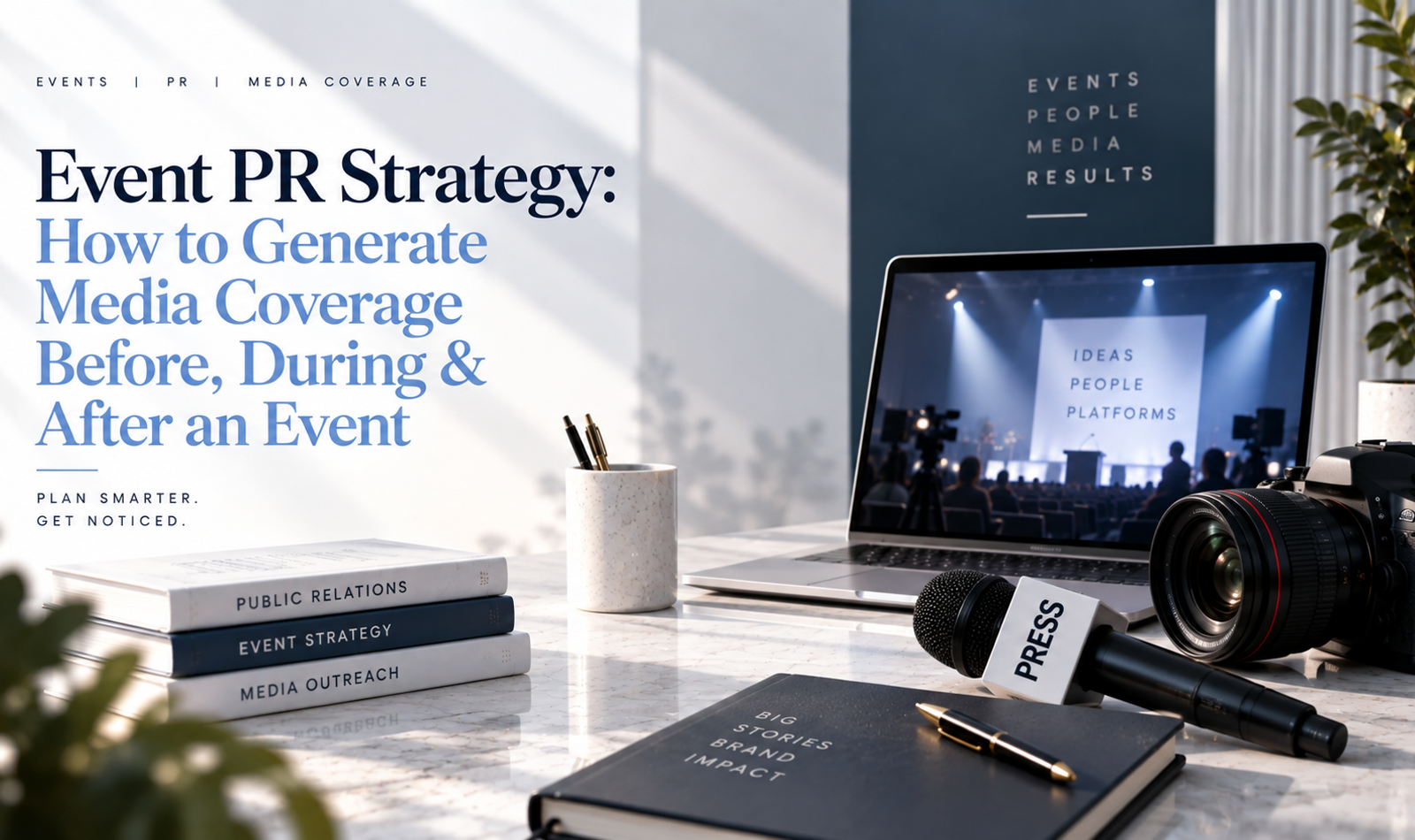
Event PR Strategy: How to Generate Media Coverage Before, During & After an Event
A successful event should create impact far beyond the people physically present in the room. Whether it is a corporate launch, luxury event, product unveiling, fashion event, conference, awards night or celebrity appearance, the right event PR strategy can turn a one-day experience into weeks of conversations, media stories and digital visibility.
But media coverage rarely happens simply because an event is impressive.
Journalists receive numerous invitations and story pitches every day. For an event to earn meaningful attention, brands need a clear story, relevant media outreach, professional coordination and a plan for extending coverage after the event ends.
This is where a structured PR and media marketing strategy becomes important.
Effective event PR begins well before guests enter the venue and continues after the stage, lights and installations have been taken down.
This guide explains how brands can build an event PR strategy across three important phases: before, during and after the event.
What Is Event PR?
Event PR is the strategic use of public relations, media relations, storytelling and communications to generate awareness and credible visibility around an event.
Unlike event advertising, where a brand pays directly for exposure, PR primarily focuses on creating stories and moments that journalists, publications, creators and other relevant voices consider worth covering.
Event PR can support:
- Brand awareness
- Media visibility
- Product or service launches
- Founder positioning
- Celebrity amplification
- Industry credibility
- Social media conversations
- Search visibility
- Stakeholder communication
- Post-event brand recall
The objective should not simply be to get the event mentioned somewhere. The stronger objective is to place the right story in front of the right audience through the right media channels.
Why Media Coverage Matters for Events
An event has a natural limitation: only a certain number of people can attend.
Media coverage can expand that audience considerably.
A room containing 300 invited guests may generate content that eventually reaches thousands of relevant consumers, professionals, investors, partners or industry stakeholders.
Strong media coverage also creates something advertising cannot always replicate in exactly the same way: third-party credibility.
When a reputable publication discusses a launch, interviews a founder or reports on an important announcement, the brand is being introduced through an independent media platform rather than only through its own communication channels.
For brands building broader communication ecosystems, event PR can also form part of an integrated brand communication strategy across PR, social media, websites and events.
Phase 1: Building PR Momentum Before the Event
Some of the most important PR work happens before the event begins.
Waiting until event day to think about journalists, photographers, interviews and media coverage usually means losing valuable opportunities.
1. Define Clear PR Objectives
Start by deciding what the event should achieve from a communication perspective.
Different events require different PR objectives.
A new product launch may focus on product awareness and reviews.
A corporate conference may focus on thought leadership.
A luxury event may aim to strengthen brand positioning.
A celebrity-led event may focus on entertainment and lifestyle coverage.
A startup event may prioritize founder interviews and business publications.
Define the primary objective first because it determines the media list, story angles, spokesperson strategy and post-event measurement.
2. Identify the Newsworthy Story
A common PR mistake is assuming that the event itself is automatically news.
It usually isn't.
Journalists need a reason why their audience should care.
Ask:
What is actually new, relevant, interesting or culturally significant about this event?
Potential PR hooks include:
- A major product launch
- A new market entry
- An industry-first initiative
- An interesting brand collaboration
- A celebrity appearance
- A significant company announcement
- A founder's unique perspective
- New research or data
- A social or cultural initiative
- An emerging industry trend
The event becomes the platform through which that story is communicated.
Brands that need a stronger narrative foundation can also explore how story-led PR helps build a compelling brand narrative.
3. Build a Relevant Media List
A large media database does not automatically produce better PR.
Relevance matters more than volume.
If you are launching a luxury fashion collection, fashion, luxury, lifestyle and relevant business journalists may matter more than sending the invitation to hundreds of unrelated contacts.
Depending on the event, your media list might include:
- Business journalists
- Lifestyle editors
- Fashion publications
- Entertainment reporters
- Technology journalists
- Startup publications
- Hospitality media
- Luxury publications
- Trade publications
- Regional media
- Digital publications
- Television teams
- Photographers
- Relevant creators and influencers
The goal is not to invite everyone. It is to identify the people whose audience aligns with the event and brand.
Long-term results also improve when brands invest in building strong media relationships rather than approaching journalists only when coverage is required.
4. Prepare the Press Release
A strong press release should answer the essential questions quickly:
What is happening?
Who is involved?
Why does it matter?
When and where is it happening?
What makes the story relevant now?
Avoid turning the release into an advertisement.
A journalist should be able to understand the actual story within the first few paragraphs.
Depending on the announcement, the press release can include:
- Headline
- Strong opening paragraph
- Key announcement
- Event details
- Supporting information
- Relevant data
- Founder or spokesperson quote
- Brand background
- Media contact information
5. Build a Professional Media Kit
Journalists should not have to search multiple places to find basic information about your event.
Prepare a media kit containing the assets they are most likely to need.
This may include:
- Press release
- Brand overview
- Founder biography
- Speaker biographies
- Product information
- High-resolution logos
- Professional brand photographs
- Event schedule
- Key facts
- Interview availability
- Media contact information
Keep the assets organized, clearly labelled and easy to access.
6. Send Personalized Media Invitations
Generic mass invitations are easy to ignore.
Instead of treating every journalist identically, personalize priority outreach where possible.
A useful invitation should communicate:
- What the event is
- Why it may interest that journalist
- Date and venue
- Important attendees
- Interview opportunities
- Major announcements
- RSVP instructions
- Media contact details
Personalized pitching becomes particularly important when targeting premium publications. Our guide to securing media features through better pitching, relationships and timing explores this in greater depth.
7. Use Founders and Spokespeople Strategically
Sometimes the most interesting story is not the event itself but the person behind it.
Founders, executives, designers, experts and creative directors can provide journalists with perspectives that turn an announcement into a stronger editorial story.
Instead of only saying:
"Our company is launching a new product."
The founder may be able to discuss:
- Why the category is changing
- Consumer behaviour
- Industry challenges
- Market opportunities
- The company's vision
- Lessons from building the brand
This can create interview and thought-leadership opportunities around the event.
Brands interested in building leadership visibility can also explore founder PR and personal branding for CEOs and entrepreneurs.
8. Use Celebrities and Influencers Carefully
Celebrities and creators can dramatically increase the visibility of an event, but their involvement should have strategic relevance.
A celebrity should ideally strengthen the event's audience connection, brand positioning or media appeal rather than simply being present for photographs.
If a celebrity appearance forms a major part of the event, planning should cover media interactions, arrival timing, photography, interviews, security, hospitality and brand integration.
Our celebrity appearance checklist before event day covers several of these operational considerations.
Influencers can play a different role by producing real-time content for highly targeted digital communities. Brands planning creator collaborations should consider audience relevance, content quality, contractual deliverables and measurement, as discussed in our guide to influencer and KOL collaborations.
Phase 2: Generating Media Coverage During the Event
Once the event begins, PR becomes an operational function.
Journalists need access, information, coordination and usable content quickly.
A strong pre-event strategy can still fail if the media experience on the ground is poorly managed.
9. Create a Dedicated Media Check-In
Journalists should have a smooth arrival experience.
Depending on the event's scale, create a separate media desk or clearly identified check-in process.
The PR team should have access to:
- Confirmed media list
- Journalist contact details
- Publication names
- Interview requests
- Photography permissions
- VIP schedules
- Spokesperson availability
- Event programme
For larger events, professional guest management becomes especially useful because media, celebrities, VIPs, partners and general attendees may require different access and hospitality workflows.
10. Assign a Dedicated Media Relations Team
Journalists should know exactly whom to contact.
A dedicated PR representative can help coordinate:
- Interviews
- Press seating
- Media access
- Photography
- Quotes
- Background information
- Speaker interactions
- Product demonstrations
- Press assets
This prevents confusion and allows the media to work efficiently.
11. Create Interview Opportunities
Do not assume journalists will automatically approach founders or executives.
Create opportunities intentionally.
Before the event, identify:
- Who is available for interviews
- Which subjects they can discuss
- How much time is available
- Whether interviews are exclusive
- Where interviews will happen
- Whether photography or video is permitted
A quiet interview zone can be especially valuable at large events where stage audio and crowds make conversations difficult.
12. Capture High-Quality Photos and Videos
Post-event coverage often depends on the quality and speed of available assets.
Your event production plan should therefore include professional photography and video coverage.
Capture:
- Venue wide shots
- Branding
- Product displays
- Stage moments
- Speakers
- Founder interactions
- Celebrity arrivals
- Guest experiences
- Audience reactions
- Key announcements
- Behind-the-scenes moments
For visually driven events, production itself contributes heavily to the quality of the resulting media assets. Brands planning sophisticated experiences can explore our guide to luxury event production, stage, lighting, sound and experience design.
13. Build Strong Media Moments
Some event moments naturally photograph better than others.
Plan visual moments that clearly communicate the event's story.
Examples include:
- Product unveilings
- Ribbon-cutting moments
- Celebrity interactions
- Founder announcements
- Awards
- Panel discussions
- Branded installations
- Demonstrations
- Collaborative moments
- Audience experiences
The key is authenticity.
A media moment should feel connected to the event rather than appearing to exist solely for photographs.
14. Enable Real-Time Content Distribution
Speed matters during events.
If a publication wants to publish a story immediately, waiting until the following week for photographs may cause the opportunity to disappear.
Your PR team should be able to distribute selected photographs, key quotes, announcement summaries and approved information during or shortly after the event.
For brands using advanced visual workflows, event content can also be repurposed into high-impact digital formats. Our guide to AI video and professional editing for luxury ads and event recaps explains additional possibilities.
15. Coordinate Social Media With PR
PR and social media should not operate as completely separate teams.
While journalists create earned-media coverage, your social channels can amplify:
- Press mentions
- Event highlights
- Interviews
- Speaker quotes
- Celebrity moments
- Behind-the-scenes content
- User-generated content
- Creator posts
This creates a broader communication ecosystem around the event.
A well-integrated approach can be particularly powerful for hybrid luxury events that combine offline and digital experiences.
Phase 3: Extending PR After the Event
The event ending does not mean the PR campaign should end.
In many cases, some of the strongest media opportunities appear afterward because the PR team now has photographs, quotes, attendance information, announcements and actual event outcomes.
16. Send a Post-Event Press Release
A post-event release should not simply say that the event happened.
Give journalists something useful.
Include:
- Important announcements
- Key event highlights
- Notable attendees
- Founder or spokesperson quotes
- Product information
- Relevant results
- High-quality photographs
- Links to additional assets
Send the release promptly while the event remains timely.
17. Follow Up With Journalists
Professional follow-up is essential.
Some journalists may have attended but not yet published. Others may have been interested but unable to attend.
A useful follow-up can include:
- Brief event recap
- Key announcement
- Selected photographs
- Quotes
- Interview opportunities
- Link to media assets
Avoid repeatedly asking:
"Did you publish our story?"
Instead, provide something that makes their job easier.
18. Pitch Post-Event Story Angles
A single event can generate multiple editorial angles.
For example, a product launch could lead to:
- Founder interview
- Industry trend story
- Product feature
- Business expansion story
- Design story
- Technology story
- Consumer trend analysis
A luxury corporate event may similarly generate business, leadership, lifestyle and event-industry angles. If you're planning the event itself, see our guide on how to plan a luxury corporate event in India.
19. Amplify Earned Media
When credible publications cover the event, do not allow those articles to disappear after one social media share.
Repurpose earned coverage across:
- Instagram Stories
- Website press sections
- Newsletters
- Sales presentations
- Investor decks
- Brand credentials
- Founder profiles
- Event recap content
One quality media feature can therefore become a long-term credibility asset.
20. Repurpose Event Content
An event can generate weeks or even months of content.
A single event may produce:
- Short-form videos
- Speaker clips
- Founder interviews
- Photo carousels
- Behind-the-scenes content
- Quote graphics
- Press highlights
- Case studies
- Blog articles
- Testimonials
- Recap films
This is why content planning should happen before the event rather than deciding afterward what to do with whatever footage happens to be available.
For launches specifically, our guide to luxury product launch events explains how experience design and content opportunities can work together.
How to Measure Event PR Success
PR measurement should connect activity with meaningful communication and business outcomes.
Useful metrics can include:
Media Coverage
Track the number and quality of relevant stories, interviews, mentions and features.
Quality of Publications
One highly relevant feature can sometimes create more value than numerous low-relevance mentions.
Share of Voice
Compare how much relevant conversation your brand receives relative to competitors or the wider category.
Message Inclusion
Did coverage communicate the messages the campaign was designed to establish?
Backlinks
Online publications may generate valuable referral links to your website.
Referral Traffic
Measure visitors reaching your website from media coverage.
Social Amplification
Track shares, mentions, saves, comments and other interactions around event-related coverage.
Leads and Enquiries
For commercially focused campaigns, monitor whether PR activity contributes to qualified enquiries or opportunities.
Brand Search Interest
An increase in branded searches around the event can indicate growing awareness.
PR should therefore be measured beyond simply counting clippings. For a deeper framework, read our guide on how to measure PR ROI using media value, share of voice and leads.
Event PR Timeline: When Should You Start?
There is no universal timeline for every event, but a structured campaign often looks something like this:
4–6 weeks before:
Define objectives, messaging, story angles and target publications.
3–4 weeks before:
Prepare press materials, media lists and invitations.
2–3 weeks before:
Begin targeted journalist outreach and confirm priority media.
1 week before:
Confirm interviews, spokesperson availability, schedules and event-day media logistics.
Event day:
Manage media check-in, interviews, photography, announcements and real-time content.
Within 24 hours:
Distribute priority images, key announcements and urgent follow-ups.
Within 48–72 hours:
Send post-event materials and continue targeted pitching.
Following weeks:
Develop interviews, feature stories, thought leadership and additional content opportunities.
For particularly important launches, PR can also be incorporated into a broader 90-day brand launch strategy.
Common Event PR Mistakes to Avoid
Even an expensive event can receive limited media attention if its PR strategy is weak.
Common mistakes include:
Starting PR too late — Media planning should begin before the event, not on event day.
Sending generic mass pitches — Journalists need relevant stories, not identical promotional emails.
Having no clear news angle — An attractive venue alone does not automatically create editorial value.
Inviting irrelevant media — Audience alignment matters more than the size of the media list.
Poor media hospitality — Complicated check-in and unclear access create unnecessary friction.
No spokesperson preparation — Founders and executives should understand the key messages before interviews.
Slow photo delivery — Publications working on short deadlines need usable assets quickly.
Ignoring post-event PR — Valuable stories are often developed after the event.
Measuring only the number of mentions — Quality, relevance, message delivery, reach and business impact also matter.
How Events, PR and Digital Marketing Work Together
Modern event communication is strongest when events, PR, social media, influencers, content and digital distribution operate as one strategy.
Think of the event as the content and experience engine.
PR creates third-party visibility.
Creators bring targeted communities into the conversation.
Social media distributes moments in real time.
Photography and video extend the experience digitally.
The website gives audiences somewhere to learn more or convert.
This integrated model is explored further in our guide to integrating events, PR and digital into a brand roadmap.
Why Work With an Event PR Agency?
Managing event PR requires multiple activities to happen simultaneously.
A professional team may coordinate:
- PR strategy
- Story development
- Media lists
- Journalist outreach
- Press invitations
- Press releases
- Media kits
- RSVP coordination
- Media hospitality
- Interviews
- Celebrity interactions
- Photography and video
- Real-time content
- Post-event distribution
- Coverage monitoring
- Reporting
For brands, having one coordinated team can reduce communication gaps between the event production, media, celebrity, guest and digital teams.
How Double Trouble Studio Approaches Event PR
At Double Trouble Studio, we look at event PR as part of the complete brand experience rather than an isolated press activity.
Our approach can bring together PR & media marketing, events, guest management, celebrity management, content production and digital amplification according to the requirements of the campaign.
For event-led campaigns, this means thinking about the complete journey:
What is the story?
Who needs to hear it?
Which media should be approached?
What will journalists experience at the venue?
Which moments need to be captured?
How will coverage be amplified?
What happens after the event?
This integrated approach helps turn an event from a temporary gathering into a broader communication opportunity.
Brands planning launches, corporate events, media experiences or high-profile gatherings can also explore our events and weddings services and celebrity management services.
Frequently Asked Questions About Event PR
1. What is event PR?
Event PR is the strategic use of media relations, storytelling, press outreach and communications to generate awareness and credible coverage around an event.
2. When should event PR begin?
For many planned events, PR preparation should begin several weeks beforehand. Larger launches, celebrity-led events and major corporate announcements may require longer lead times.
3. How do you get media coverage for an event?
Start with a genuinely relevant story, identify suitable journalists, prepare strong press materials, personalize outreach and make interviews, information and visual assets easy to access.
4. What should an event press kit include?
A typical media kit may contain the press release, brand background, spokesperson biographies, event information, product details, approved quotes, logos, photographs and media contact information.
5. Should journalists be paid to attend an event?
Editorial media coverage and paid promotional placements are different activities. Brands should clearly distinguish earned media outreach from sponsored or paid partnerships.
6. Can celebrities increase event media coverage?
They can increase media interest when the celebrity is relevant to the event, audience and brand story. Celebrity involvement should still be supported by proper planning, access management and communications.
7. Are influencers part of event PR?
Influencers can form part of a broader event communication strategy, although influencer partnerships and editorial journalism operate differently. Both can help extend the event to audiences beyond the venue.
8. How quickly should event photographs be shared with the media?
Priority photographs should be processed and distributed as quickly as practical, particularly when journalists are working to same-day or next-day deadlines.
9. How is event PR success measured?
Measurement can include quality media coverage, publication relevance, message inclusion, share of voice, backlinks, referral traffic, social amplification, branded search interest and qualified leads.
10. How much does event PR cost in India?
The cost depends on the event scale, campaign duration, target publications, media outreach requirements, content production, celebrity or influencer involvement, city coverage and reporting requirements. For broader pricing context, read our guide on PR agency costs and retainers in India.
Conclusion: Turn Your Event Into a Story Worth Covering
A great event creates an experience for the people who attend.
A great event PR strategy makes that experience travel further.
The strongest campaigns do not treat PR as a last-minute press release. They build the media strategy into the event from the beginning — defining the story, identifying the right publications, preparing spokespeople, coordinating media on-site, capturing strong content and continuing outreach after the event.
The result is an event that can create value before the doors open, while guests are in the room and long after the venue has emptied.
If your brand is planning a corporate event, product launch, luxury experience, celebrity appearance or media-led activation, Double Trouble Studio can help develop an integrated strategy across events, PR, media and digital communication.
Contact Double Trouble Studio to discuss your upcoming event and PR requirements.
📩 info@dtsworld.in 📞 +91 80000 06021 📍 Andheri (West), Mumbai.
Need this for your brand?
Let DTS build your next campaign.
From PR, celebrity management and events to websites, social media, SEO and AI video production — Double Trouble Studio helps brands grow with strategy and execution.
Discuss Your Requirement →